Tuesday, September 9, 2008

My Chevette, King of the Road

Well nobody got my bad LOTR reference, I'm kinda disappointed.

Drudge linked to a pretty decent Camille Paglia opinion on salon.com. She talks herself into Sarah pretty well, though she's definitely still for BO. But it seemed to be a well balanced opinion that I can respect, though my spider sense screams radical liberal feminist from that name.

TMQ today went off on vehicle horsepower as one of the main culprits in excessive gasoline consumption in the United States. One of the highlights: "Simply knocking a third off the horsepower of new U.S. passenger vehicles would, in about a decade -- as efficient new vehicles replace wasteful old ones -- eliminate approximately the amount of oil the United States imports from the Middle East. Yes, it's that simple."

This combined with "Twenty years ago, the average new passenger vehicle sold in the United States had 120 horsepower. For this model year the figure is 230, almost double. There will be no fundamental change in oil import levels until horsepower numbers change." makes a pretty compelling case against horsepower.

Consumers have clearly demanded more HP, I suppose this reason as a main driving factor of oil dependency isn't talked about much because we have no one to blame but ourselves. Nobody wants a gutless vehicle, it makes ya feel kinda weak and flaccid. We all want to be able to commit some road rage if some fool screws up and we feel like it, I know I do. But that's why we're in the situation we're in, and we have the power to get out of it by adjusting our buying habits. So that's my rant today, here's the rest of the section of the TMQ.


Hold Your Horsepower: Gasoline demand has declined slightly since 2005. And a few months ago, Congress enacted the first tightening of vehicle fuel economy rules in two decades; barrel prices of oil are declining. So far, so good. But oil is still well over $100 per barrel, versus about $74 at this time last year, and gasoline still costs nearly a dollar more per gallon than at this time last year. The longer-term picture is bleak. In 1973, America imported 6 million barrels of petroleum daily. Currently it imports more than 13 million barrels each day. Yesterday I heard a radio announcer say, "Now that the gasoline price crunch is over …" Don't make the mistake of thinking for one minute that America's petroleum addiction is even close to fixed.

For cars, SUVs and light trucks, there are two forces at play in oil-addiction trends, but only one is generally recognized. Everybody knows the fad of big vehicles increases petroleum needs -- according to the EPA, the average weight of passenger vehicles has risen 30 percent since 1988, while average MPG is down. The other factor, little acknowledged, is horsepower, which has risen even more sharply than weight. Twenty years ago, the average new passenger vehicle sold in the United States had 120 horsepower. For this model year the figure is 230, almost double. There will be no fundamental change in oil import levels until horsepower numbers change.

Like weight, horsepower depresses fuel economy. Simply knocking a third off the horsepower of new U.S. passenger vehicles would, in about a decade -- as efficient new vehicles replace wasteful old ones -- eliminate approximately the amount of oil the United States imports from the Middle East. Yes, it's that simple. Race cars need lots of horsepower; suburban family cars do not. Excessive horsepower causes the United States to be dependent on Middle East dictatorships, engages military commitments to those dictatorships, drives up the price of oil and pushes down the value of the dollar. Horsepower is also the enabler of road rage -- rapid acceleration allows cutting off, drag racing and sudden lane changes. Road rage entered national consciousness as a problem in the mid-1990s, exactly when the horsepower ratings of new vehicles began to spike.

Yet nearly all auto companies selling in the United States continue to introduce overpowered cars that require far too much fuel. The problem transcends brands, whether domestic or international. The new BMW 550i sedan has 360 horsepower and records just 18 MPG. Pontiac's new 361-horsepower G8 GT is a small car that gets just 18 MPG. Only in America do small cars waste gasoline. Ford's new Taurus sedan has a 263-horsepower engine which delivers only 22 MPG in its front-wheel-drive variant, an awful 19 MPG in the all-wheel-drive version. The Taurus isn't a sports car, it's a family car! Toyota's new Camry, another family car, offers 263 horsepower and just 22 MPG. The Dodge Avenger, a family car, when ordered with the optional 255-horsepower engine posts just 18 MPG. Infiniti's 320-horsepower FX45, Cadillac's 403-horsepower Escalade and the 500-horsepower Porsche Cayenne Turbo achieve a dreadful 14 MPG. (All mileage figures in this column are the "combined" numbers that blend city and highway driving. Under real-world circumstances, especially stop-and-go commuting, many drivers average well below the official number.) Plus, the more horses, the more greenhouse gases. According to the EPA, a Porsche Cayenne Turbo emits 13.1 tons of greenhouse gases annually. Check any car's MPG and greenhouse numbers here.

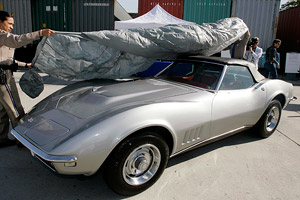
Corvette

AP Photo/Nick Ut

A 1968 Corvette -- which had less muscle than a typical 2008 family car.

Less horsepower would mean better fuel efficiency, diminished petroleum imports and lower carbon emissions but, inevitably, reduced acceleration. Don't buyers crave speed? Most cars are already too fast! Thirty years ago, the average passenger vehicle did zero to 60 MPH in 14 seconds; for 2008, the average is about 8.5 seconds. That new 263-horsepower Ford Taurus family sedan does zero to 60 in 6.5 seconds -- the same acceleration as the 1968 Corvette with the famed 427 big-block V8. The new Camry and Honda's comparable new Accord do zero to 60 in about 7 seconds. Acceleration of this type is not needed for everyday driving; such power is useful mainly for speeding, running lights and cutting others off. Lexus has aired ads boasting that its new IS-F model, with a 416-horsepower engine, does zero to 60 in 4.6 seconds; the new 480-horsepower Nissan GTR is even faster at 3.8 seconds. Both have dismal mileage ratings. Lexus is telling the business media the IS-F is intended for the United States and won't be pushed in the company's home market of Japan. There, the IS-F's road-rage engineering and 10.2 tons of greenhouse gases released annually might be controversial.
In addition to reducing fossil-fuel use, dialing down horsepower would reduce highway deaths. Researcher Michael Sivak of the University of Michigan's Transportation Research Institute has found that highway fatalities dropped sharply earlier this year as gas prices shot up, with highway deaths declining 22 percent in March and 18 percent in April. (Note: You can reach the Transportation Research Institute only by car.) This spectacular decline in deaths, receiving little public notice, came about, Sivak found, mainly when drivers slowed down in order to improve MPG. High-horsepower vehicles encourage speeding, because they make soaring above the speed limit feel effortless. If horsepower were reduced by sensible amounts, there would be less driving 80 MPH in 60 MPH zones, or 50 MPH in 30 MPH zones. Sivak's numbers suggest that if America became sensible about speed, perhaps 8,000 lives per year could be saved. Eight thousand lives per year would represent more Americans saved than if all incidents of drowning were eliminated.

Federal legislation to regulate the horsepower of passenger vehicles, perhaps by establishing a power-to-weight standard, would reduce petroleum consumption, cut greenhouse gas emissions, lower U.S. oil imports, strengthen the dollar, and take some of the road-rage stress out of driving. So what are we waiting for? Whatever your answer, don't reply, "No one can tell me what I can drive." Courts consistently rule that vehicles using public roads may be regulated for public purposes, such as safety and energy efficiency. NASCAR races occur on private property -- there, horsepower is nobody's business. On public roads, horsepower is very much everybody's business. You'd be laughed at if you asserted a "right" to drive a locomotive down the freeway. Where is it written we have the "right" to operate an overpowered car that wastes oil and pollutes the sky?
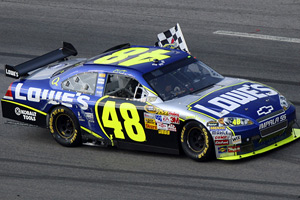
Jimmie Johnson

AP Photo/Scott k. Brown

NASCAR cars need high horsepower, cars bound for suburban shopping malls do not.

Meanwhile, all the talk lately has been about getting drivers into hypothesized future vehicles that might get excellent mileage, such as plug-in hybrids. Even assuming such cars someday are in showrooms, the payoff is greater for getting people out of low-mileage vehicles right now, because low-mileage vehicles are disproportionate consumers of fuel. Assume an average year of 12,000 miles traveled. The driver who trades in a 15 MPG SUV or high-horsepower car for a 20 MPG standard-engine full-size car would reduce fuel use by 200 gallons. The driver who trades in a 20 MPG full-size car for a 25 MPG midsize would reduce fuel use by 120 gallons. The driver who trades in a 25 MPG midsize for a 30 MPG compact would cut fuel use by 80 gallons. The driver who trades in a 30 MPG compact for a 35 MPH current-technology hybrid would save 60 gallons. And the driver who trades in a 35 MPG current-technology hybrid for a 40 MPG advanced plug-in hybrid would save 40 gallons. By far the best oil-reduction bang for the buck lies in people giving up large SUVs, pickup trucks used for commuting, plus any type of overpowered vehicle, in favor of driving regular cars. The math is presented in detail in this paper by Richard Larrick and Jack Soll of Duke University. This suggests that instead of tax policy being focused on credits for buyers of high-mileage hybrids, and federal subsidies being focused on the development of high-mileage hypothesized future designs, tax policy should reward those who junk SUVs in order to buy regular cars. Tax programs to encourage drivers to junk old high-polluting automobiles were successful, so a junk-your-SUV program might work, too.

Saturday, August 30, 2008

Palantir

It feels like time to glance into the seeing stone again, dangerous though it might be. I'm really liking Johnny MC's choice for VP. It seems a calculated, risky move, and it works for me.

I feel like I can now settle into a calm peace over this election, as there is a nice symmetry between both tickets, and the country is going to move forward no matter what. I'm not seeing much of a further reason to get worked up over the Presidential Election, I like both tickets. They have different strengths and weaknesses, and I can support who wins, for different reasons.

I think it is a crazy risk for JMC to pick a 44 year old former pageant contestant with even less experience than BO. But I like the direction that it potentially takes this country in. The rise of the outsiders. The Washington elite cannot control everything, or so it would seem. And I'm really glad he didn't pick Romney.

I think the race that I am going to have to put some thought into is the senate race here in Orygun. Smith or Merkley. It's going to be close, it's going to matter, and I'm still undecided. Smitty lost some points with me when he ran a TV ad with his name in the Oregon Ducks font, thunder green and all. I suppose I'll have to look at some actual issues, and I expect to have that chance. But if there is a race to have a debate about around here, I think that's the one.

I don't know if my hand will physically be able to mark the bubble for democrats in the two biggest races though. My red roots bristle at the very notion even now. Apparently I haven't completely been turned. Something within me feels like my first vote for a major candidate in a presidential race should be a republican, just because I thought nothing but red for so long. But I never actually voted red, some beaucratic snafu intercepted my ballot in '00, and in '04 I really wanted to vote for Bush but the midichlorians within me and the war prevented me from actually marking the bubble so I voted for Jesus. So my conclusion is that it doesn't really matter who I vote for Pres, (but in a good way) and I don't have a clue in the senate race yet. I believe I did vote for the Merk in the primary though.

On a different government conspiracy note, I passed my Praxis II exam in math that I took last month apparently. The state of Oregon pretty much considers me qualified to teach calculus. And that's awesome don't get me wrong thank you Jesus.

But I can't shake the feeling that the powers that grade are either smoking crack or just have a quota of a % or number of people that must pass. Because by any objective standard I bombed the written response portion. It was 4 questions. I aced the first one, but used about 25 of my 60 minutes. The second one I feel I got the first half, and then I didn't have much of a clue on the rest of the test. I did write a very limited amount down, which I almost didn't do because I knew I wasn't close to a solution. But I maybe wrote a total of 4 lines for the last two and a half problems, and it would take about a page and a half minimum to present a correct solution.

So that's kind of messed up but I guess I'll take it. I scheduled the "Technology Education" one for November, and after that I still may do Social Studies. But it sounds like those jobs are pretty popular, and I'm not that gung-ho about it so it might not be worthwhile at this point in my career. Class is going fine, its a ~25 person cohort and I think it will be a good program; I'm enjoying it so far. I need to get my butt in a school volunteering though.

I got a new $600 dell lappy with some of my student loan money, not totally confident that was a solid decision but the old one was pretty painfully slow, even by my very tolerant standards. Isaac is going to wipe it and install linux though, I think in that form it will have some life left. I'm pretty happy with the new, it's from the small business area of their website, and I think as such it's got less crap pre-loaded on it.

With Keith in the UAE for a couple months I'm in a little less of a hurry to drive something other than his Susui Azztorpp for my very limited use. Although the tranny does appear to be going out again, which is a bad deal. But I'm just not going to use it but for work, until I can find something worth buying. I've been looking and have seen a few maybe's but nothing that was amazing yet in the 700-1500 range. But it'll come.

The bicycle commuting is working like a champ though. I got a front basket on today, 12 bucks and its removable so I can use it in the store as well. I'm trying out spud.com for produce delivery every other week; the stuff might be a little more expensive but its good and I'm actually eating it which is a big step.

And the Blazers are going to be the shizzle this season.

Wednesday, August 20, 2008

NYT's BO

This was my lunchtime reading today: http://www.nytimes.com/2008/08/24/magazine/24Obamanomics-t.html?pagewanted=1&_r=1

Speaking of inobjectivity, the author seemed pretty well in love with Obama, but I believe it was well written and informative for the most part anyway. If that is indeed the way his tax plan is laid out, I'm all in favor. Now I need to find the opposing view.

Tuesday, August 19, 2008

TMQ

TMQ is back at the ESPN, and the following is one of his rants on CEO compensation. I believe there was a conversation a while back on Hartzell's blog about CEO's, and something like this was what I thought of but couldn't find to link to at the time. It's pretty outrageous.


Government Policy Rewards CEO Lying, So We Get More of It: Increasingly Fannie Mae and Freddie Mac are looking like little more than devices to transfer money from the pockets of taxpayers to the pockets of Fannie and Freddie senior executives. Former Fannie Mae boss Franklin Raines paid himself about $50 million for years in which, we now know, the company lied about its earnings in order to inflate executive bonuses, while management was playing fast and loose with other people's money. Beginning in 2007, Fannie Mae and Freddie Mac went off the cliff, their stocks plummeting to less than 20 percent of their previous values, and taxpayers were put on the hook as guarantors of the firms' bad management decisions. The Congressional Budget Office estimates the Mae-Mac debacle will cost taxpayers $100 billion or more. Yet Freddie Mac CEO Richard Syron was paid $14.5 million for 2007, including a $2.2 million "performance bonus." Syron has taken home $38 million total from Freddie in the past five years. Fannie Mae CEO Daniel Mudd got $14.2 million for 2007, plus a substantial prepaid life insurance policy and other perks including "financial counseling, an executive health program and dining services," the Washington Post reported. Hey, $49,000-a-year median U.S. households, you are being taxed for millionaire Mudd's "dining services." Bon appetite.

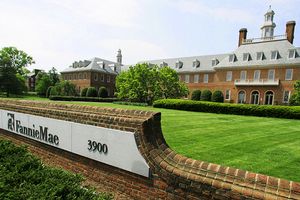
Fannie Mae

AP Photo/Manuel Balce Ceneta

The headquarters of a racketeering group engaged in organized crime.

Executives receiving very high pay justify their deals on two grounds: that they are risk-takers in high-pressure situations, and that they have valuable expertise. Now we know that no one at the top of Fannie Mae and Freddie Mac took any personal risks -- everything was federally guaranteed, and all mistakes billed to the taxpayer. Here, the New York Times reports that Syron was repeatedly warned in 2004 that the organization was taking on bad loans, and did nothing. Syron justified his inaction by complaining to the Times that he was under pressure from various Fannie constituents. That's why he was paid so much, to take the heat! Yet he took no heat, rather, devoted himself to avoiding responsibility. If things go well, executives are lavished with money and praised as risk-takers. If things go poorly, executives are lavished with money and blame others.

And just what incredible expertise do Syron and Mudd possess? They made billion-dollar blunder after billion-dollar blunder; they failed to realize things as basic as buyers borrowing without documentation of income may not be able to repay loans. People chosen at random from the phone book could hardly have performed worse. Yet the federal bail-out legislation just signed by George W. Bush does not require them to give back any of their ill-gotten gains.

This is the core lesson of CEO overpay scandals: The corrupt or incompetent executive always keeps the money. He may be caught and embarrassed by bad press, but he keeps the money while someone else -- shareholders, taxpayers, workers -- is punished. Raines recently settled a federal legal complaint by agreeing to return about $3 million of his $50 million, but kept the rest; his employment contract was worded such that even if he was malfeasant, whatever he took from company coffers was his. Hilariously, federal prosecutors claimed victory because Raines "surrendered" to the government a large block of stock options -- options now worthless, owing to the Fannie Mae decline Raines helped set in motion by lying about Fannie numbers. Until Congress enacts a law that allows money taken by corrupt or incompetent executives to be recovered, the lying will continue. Lying by CEOs is what society rewards!

Why does Congress tolerate the swindle aspect of Fannie and Freddie? For the standard reason: Congress is on the take. Here, Lisa Lerer of Politico reports that in the past decade, Fannie and Freddie spent almost $200 million on campaign donations to Congress and on lobbying members of Congress, some of the lobbying money going to former members. This year, for instance, Fannie gave the legal max of $10,000 to Speaker of the House Nancy Pelosi and to Republican House Whip Roy Blunt, neither of whom face meaningful re-election challenge. As for costly lobbying, the implied deal is: Don't rock the boat while in office and someday you too will be a former member getting easy money to lobby former colleagues. During Senate debate on the Mae-Mac bailout, Majority Leader Harry Reid refused to permit a vote on an amendment that would have barred Fannie and Freddie from giving money to members of Congress. Reid did not merely oppose the measure, he refused to allow the Senate to vote on it -- so that members of Congress could remain on the take, without having to go on record about the matter.

Now that taxpayers are covering Fannie and Freddie's cooked books, the $200 million diverted to Congress in effect came from average Americans, forcibly removed from their pockets -- and thanks to Senator Reid, more will be forcibly taken from your pocket and placed into the accounts of senators and representatives. This is what TMQ calls a Sliver Strategy. The Sliver Strategy is a means to disguise embezzlement. Congress looked the other way while Fannie and Freddie approved vast amounts of bad debt, in order to shave off a sliver for itself -- in this case, the $200 million in lobbying and donations. Had Congress simply awarded itself $200 million, editorialists would have been outraged. Because the money was slipped in to a larger fiasco of much greater sums wasted, Congress got away with it.

Monday, August 18, 2008

whoot

Well I moved on saturday. With my brother to the extra bedroom at the Ketah's. And it sounds like David's going to move back in with our parents on wednesday. I have pretty mixed feelings on that, but it could be good. I know it'll all work out one way or another.

I start school next week, and have my orientation on wednesday, and I feel like I'm ready. New house, new school, and I'm still getting married. Time marches on.

I'm almost ready for politics to start back up again, as soon as the Olympics are over. Both frontrunners kinda make me grumpy, and it seems likely Oregon will be blue no matter what I do, but it's going to be time for saturation coverage soon and I'll be ready. I guess what frustrates me right now is it doesn't seem like anybody has an objective opinion, everybody just likes the guy you'd expect them to, or spends too much time joking about stuff, including myself. If there's no hope in anyone changing their mind, what's the point of discourse? I secretly enjoy being proved wrong and changing my mind, but then I get painted as an unreliable flip-flopper. So there is no winning, but it's a battle that must be fought anyway. Sigh.

Wednesday, August 13, 2008

Marriage

Good evening internets, it's been a little busy lately, but there is some news for those who haven't heard. Ginny and I are now engaged and will be married sometime next spring, Lord willing and we live. I think it's pretty fantastic. Life is good. I will likely be doing most of the wedding planning, and I'm looking forward to it. So there.

Also, I'm moving this weekend to nopo and start school about the week after that. And I have to buy a crappy car in the next couple weeks, which I don't really want to do but I must for work.

But mostly Ginny and I will be married, and that is awesome. She is amazing to me, beautiful in every way, and I love her. I'm very confident we will be quite happy together. yeah...

Saturday, August 2, 2008

love, liberty, disco

Well I successfully went to the REI garage sale this morning and only spent 8 dollars. And I was there for 5 freaking hours too. They started at 8, so we got there a little after 7. And didn't get let in until about 1030. Sheesh. I think I'm either not going again, so I'm just going to go ahead and spend the night.

But I wasn't looking for much today, and I found it. A pair of Chaco sandals for Ginny for 20 bucks, and something random for me. Which ended up being some bike fenders for 83 cents that didn't have any hardware. Hopefully I can rig at least one of them up, I think it was a good risk. And I had 10 dollars left on a gift card from christmas I'd forgotten about and a 3 dollar dividend to use, so I only had to actually spend 8, it was awesome. The sandals even fit her. They're regularly 70 and I essentially got them for 7, so I think it was worth my time.

We tried to watch some of the Flugtag, but it was just waaay crowded. By my estimate there was definitely more people there for that than there was for Obama, but Oregonlive seems to be calling it a push at 80k. Ended up sitting on a bench at OMSI, we could see objects falling and people jumping in after them, but not specifically what they were. But I just enjoy being part of a crowd.